
April 9, 2026
If you have discovered a hollow trunk or fungal “conks” growing at the base of your Western Red Cedar or Bigleaf Maple, your first instinct is likely worry. In Bellingham’s rainy, wind-prone climate, internal decay is a common reality, but it isn’t always a death sentence.
When evaluating a tree with rot, the real question is not simply “Is the tree alive?” but rather, “Is it structurally safe?” Most tree failures happen when internal decay goes unnoticed for years, not when trees are already obviously dead and brittle.
Key Takeaways
- Preservation is Possible: Decayed trees can often be saved if the remaining outer “shell” of sound wood is sufficient to maintain structural integrity.
- The 30% Guideline: As a general rule, a tree needs at least one-third of its trunk radius to be considered sound wood and stable.
- Species Matters: Western Red Cedars often compartmentalize decay well, while “Brown Rot” in Douglas Firs can lead to more brittle, high-risk conditions.
- Landmark Protection: Bellingham’s current emergency ordinance protects most trees over 36″ DBH, requiring professional risk assessments before removal permits are granted.
- Modern Diagnostics: Tools like Sonic Tomography allow arborists to see inside the tree without cutting into it, providing a data-driven path to saving high-value trees.
Why Bellingham Trees Develop Internal Decay
Our local environment is a paradise for wood-decay fungi. Constant moisture and mild temperatures create the perfect incubation chamber for pathogens. After consecutive wet winters in Whatcom County, we often see root rot expansion accelerate in older Douglas Firs growing in compacted urban soil. Furthermore, trees growing in compacted construction soils, common in Bellingham’s newer developments, tend to show faster internal decay progression due to chronic root stress and reduced oxygen exchange in the root zone. Critically, trees with internal decay often fail first during saturated soil plus wind combination events, rather than during dry, late-summer windstorms.
In Bellingham, we primarily see two types of internal decay:
- White Rot: This fungus breaks down both lignin and cellulose. The wood becomes soft, spongy, and moist. You’ll often see this in our Bigleaf Maples and Cottonwoods.
- Brown Rot (Cubical Rot): Common in Douglas Firs and Hemlocks, this attacks cellulose, leaving behind brittle, brown chunks of lignin that crumble easily. Brown rot is often more dangerous because the wood loses its structural “flex” very quickly.
Common Fungal “Fingerprints” in Whatcom County
Keep an eye out for these specific local “bad actors” during your own tree risk assessment:
- Artist’s Conk (Ganoderma applanatum): Flat, shelf-like mushrooms. If you see these on a Maple or Birch, internal heartwood decay is likely advanced, often extending several feet above and below the visible conk, according to UMass Extension research.
- Honey Mushrooms (Armillaria): Often found at the base of the tree. This is a root-killer that uses string-like rhizomorphs to destabilize a tree, leading to uprooting during our notorious winter windstorms long before the canopy looks thin.
- Red-Belted Conk: Very common on our conifers; it indicates a brittle type of rot that requires immediate inspection.
DIY Tree Decay Inspection: What Homeowners Can Safely Check
While professional tools provide the full picture, you can perform a basic Level 1 risk assessment at home to spot early red flags. Always prioritize safety, and never climb a tree without professional training and gear.
- Visual Scan: Look for deep cavities, cracks, a sudden lean greater than 15 degrees, or canopy dieback (dead branches) concentrated on one side of the tree.
- Sound Test: Gently tap the trunk at several points around its circumference with a rubber mallet. Healthy wood typically sounds solid and “bright,” while decayed wood often produces a dull, hollow “thud.”
- Probe Gently: Use a long screwdriver or a thin metal probe. If the tool sinks more than 3-4 inches into the trunk or root flare with little resistance, internal rot may be advancing.
- Root Flare Check: Inspect the base of the tree where the roots meet the trunk. Look for mushrooms, girdling roots (roots wrapping around the trunk), or soft, sunken soil.
If you identify any of these red flags, document them with photos and consult an ISA Certified Arborist. These early observations can help prioritize urgent cases before the next major storm.
How Arborists Judge Whether a Hollow Tree Is Still Safe
Arborists use specific guidelines to determine if a hollow tree is still safe to stand near your home. While every tree is different, a commonly used guideline in arboriculture is:
The 30% Rule: To be considered structurally stable, a tree generally needs at least one-third (33%) of its radius to be sound, un-decayed wood.
Example Calculation: Imagine you have a Douglas Fir with a 30-inch diameter (15-inch radius). To be considered stable, it needs at least 5 inches of solid, healthy wood “shell” around the exterior. This threshold is a primary factor in structural support assessments. If a probe or test shows only 2 inches of sound wood remains, the tree is likely a candidate for tree removal or significant weight reduction.
Note: Actual safety thresholds vary by species, decay location, and exposure to wind. A tree with significant decay on the windward side may be riskier than one in a protected area.
However, trees are incredibly resilient. They often grow “reaction wood,” thickening the trunk around the decay area, which can sometimes compensate for internal hollows.
Advanced Internal Decay Testing in Bellingham
When a visual inspection isn’t enough to make a safety determination, arborists use non-invasive diagnostic tools to “see” inside the wood. For high-value or landmark trees, these tests provide the data needed to justify preservation.
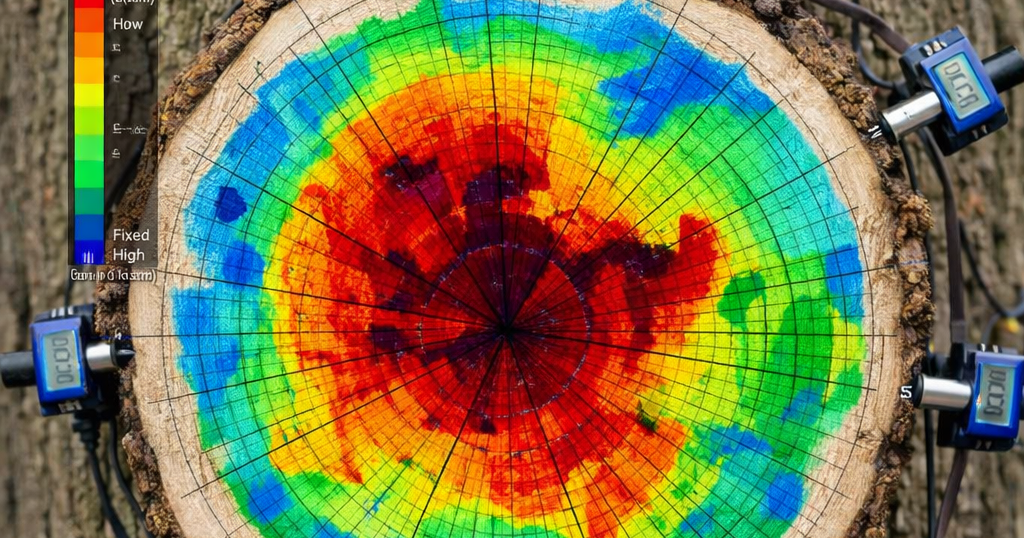
Sonic Tomography (PiCUS)
This is essentially an MRI for your tree. Sensors placed around the trunk send sound waves through the wood. Since sound travels more slowly through decayed wood than through solid wood, the software generates a color-coded map:
- Blue/Violet: Solid, healthy wood.
- Red/Yellow: Areas of decay or hollows.
Resistograph Micro-Drilling
Think of this as a micro-biopsy. This tool uses a tiny, needle-like drill bit to measure wood density. If the drill suddenly meets no resistance, a pocket of rot has been found. This provides precise measurements of exactly how many inches of sound wood remain.
Ready for a scan? Schedule a Free Assessment
Options to Stabilize a Tree With Internal Rot
If decay is present but the tree is not an immediate hazard, professional arborists can intervene to prolong its life. It’s often about managing the weight and stress on the trunk rather than “curing” the rot itself.
- Weight Reduction Pruning: By thinning the upper canopy or shortening heavy limbs, we reduce the “lever arm” effect, meaning the wind won’t exert as much force on the weakened trunk.
- Cabling and Bracing: We can install high-strength steel or synthetic cables to support heavy limbs, transferring the load to stronger parts of the tree.
- Soil Health & Mulching: Improving the “Critical Root Zone” with high-quality mulch and aeration helps the tree “compartmentalize” (wall off) the rot more effectively.
Preventing Tree Decay: Proactive Steps for Bellingham Homeowners
Internal decay often stems from preventable environmental stressors. Protecting your trees long-term in our wet PNW climate requires a proactive approach. It’s much easier to prevent rot than it is to stop it once it starts.
- Proper Mulching: Apply 2-4 inches of organic mulch across the Critical Root Zone (extending to the drip line). Crucially, keep the mulch 6 inches away from the trunk to prevent moisture buildup and bark rot.
- Avoid Trunk Wounds: Entry points for fungi are often caused by lawnmower strikes, string trimmer nicks, or improperly installed staking wires. Protect the base of your trees to keep pathogens out.
- Strategic Pruning: Remove deadwood annually during the dormant season. Thinning the crown can improve airflow and reduce the “wind sail” effect during winter storms.
- Address Soil Compaction: In urban settings, compacted soil restricts oxygen and water flow to the roots, stressing the tree. Aeration and high-quality compost can revitalize the soil environment.
Recent Whatcom County windstorms with gusts exceeding 60 mph underscore the value of prevention. Healthy, well-maintained trees weather the “Bellingham Blow” far better than those weakened by stress.
Landmark Tree Rules in Bellingham
Bellingham recently enacted an Emergency Landmark Tree Ordinance, with interim rules currently extended through March 2025. Under these rules, any healthy tree with a diameter of 36 inches or greater is automatically part of the city’s landmark inventory and receives heightened protection.
Note: Black Cottonwoods are currently excluded from this specific landmark protection regardless of size.
If a Landmark Tree shows signs of decay, the city may require a formal risk assessment by a TRAQ-certified (Tree Risk Assessment Qualified) arborist to document that the tree poses an unacceptably high risk before approving a removal permit. Our team can help you navigate this permit process and coordinate directly with city officials.
Frequently Asked Questions
Can I fill a tree hollow with concrete?
No. This is an outdated practice that traps moisture, speeds up rot, and makes the tree too rigid. Trees need to flex in Bellingham’s high winds; a concrete core prevents this, often leading to sudden, catastrophic trunk failure.
If there is a hole in my tree, does it mean it’s dying?
Not necessarily. Many trees “wall off” the rot, a process called compartmentalization, and live for decades with a hollow center. Our concern is structural stability (will it fall?), not necessarily the biological health of the leaves.
How much does an internal decay test cost?
A basic visual assessment is often part of a free estimate. Advanced Sonic Tomography or Resistograph testing is a specialized service, usually ranging from $300 to $700, depending on the tree’s size. For landmark trees, this is a small price compared to the cost of removal or property damage.
Can wood-decay fungus spread to my house?
Generally, no. The fungi that eat living or dead tree heartwood (like White Rot or Brown Rot) are specifically adapted to wood fibers and moisture levels found in trees. They are not the same species that cause “dry rot” in home foundations.
Schedule a Tree Risk Assessment in Bellingham
Don’t wait for the next “Bellingham Blow” to find out if your tree is hollow. An ISA Certified Arborist can provide a definitive answer on whether your tree can be saved or if it poses a threat to your property.
We provide the documentation required for the City of Bellingham’s landmark tree permits and can develop a long-term preservation plan for your property’s most valuable assets.
Contact Earthworks Tree Service for a Professional Evaluation