
July 29, 2026
Note: This case study is based on a typical hazardous Douglas fir removal project performed by Earthworks Tree Service. Specific details have been adjusted to protect client privacy.
A Bellingham homeowner in the Sehome neighborhood called us on a Wednesday morning in mid-November.
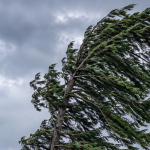
The previous night’s windstorm had shifted something. A large Douglas fir at the back of the property, which had stood for decades without anyone giving it much thought, was now visibly leaning toward the house. The lean was subtle, but it was new, and it was enough to raise concern. The tree now pointed directly toward the master bedroom.
The homeowner had been watching the tree for nearly two years. Although it appeared healthy, she had noticed the soil around the base lifting slightly after heavy rain events. She mentioned it to a neighbor, but neither considered it serious enough to warrant a professional assessment.
The windstorm changed that calculation.
Key Takeaways:
- A tree that has shifted position after a windstorm requires immediate professional assessment, not a wait-and-see approach.
- Root zone inspection on Pacific Northwest conifers often reveals significantly more damage than crown appearance suggests.
- Removing a large tree over a structure requires crane work, detailed rigging plans, and crew coordination that goes well beyond standard tree felling.
- PNW soil saturation during fall and winter actively worsens existing root zone failures, making early intervention critical.
- A tree that appears “mostly fine” after a windstorm event may be in a structurally compromised state that will fail under the next moderate load.
- Early scheduling in the wet season costs less and carries less risk than waiting for the situation to become a full emergency.
Why Do Cases Like This Happen in the Pacific Northwest?
Bellingham’s wet climate creates conditions where root problems can develop unnoticed for years. Prolonged soil saturation weakens root systems and reduces tree stability, particularly during the fall and winter storm season. Mature Douglas firs often appear healthy from above even when significant root damage exists below ground. In many cases, a windstorm does not create the problem. It simply exposes a structural failure that has been developing over time.
Similar conditions are commonly observed on properties throughout Bellingham, Fairhaven, Sudden Valley, and other parts of Whatcom County during the wet season.
When Does a Tree Like This Need Emergency Assessment?
Any tree that has shifted to a new lean following a windstorm or rain event requires a same-day or next-morning assessment. Do not wait for business hours the following week. Root zone movement that has begun is unlikely to stabilize on its own, and the wet season conditions common in Whatcom County actively worsen the situation with continued rain loading.
Phase One: Initial Assessment
What We Found on Site
We arrived the morning after the homeowner’s call and found a 90-foot Douglas fir leaning toward the southeast corner of the house. The previous night’s windstorm had shifted the tree and exposed a developing structural failure.
Root collar inspection revealed soil separation and partial lifting of the root plate. Further investigation found soft, decaying root tissue consistent with Armillaria infection, which had likely weakened the tree for several years before the windstorm triggered movement.
Despite the damage below ground, the crown appeared healthy, with normal foliage density and no visible dieback. This is a common pattern on Whatcom County properties, where serious root problems can develop long before visible symptoms appear in the canopy.
Note: Crown appearance is not a reliable indicator of root zone health on Pacific Northwest conifers. This tree looked completely healthy from a distance. It was not.
Phase Two: Site Assessment and Planning
Why This Removal Required a Crane:
Standard tree felling involves cutting the tree and directing the fall to a clear landing zone.
On this Bellingham property, there was no clear felling zone. The house occupied the tree’s fall direction. The neighboring property fence and a utility line occupied the east. The driveway and a vehicle were to the north.
This is a confined-space removal, which means the tree cannot fall. It has to be dismantled from the top down, with each section rigged and lowered rather than allowed to freefall. For a tree this size, that requires a crane.
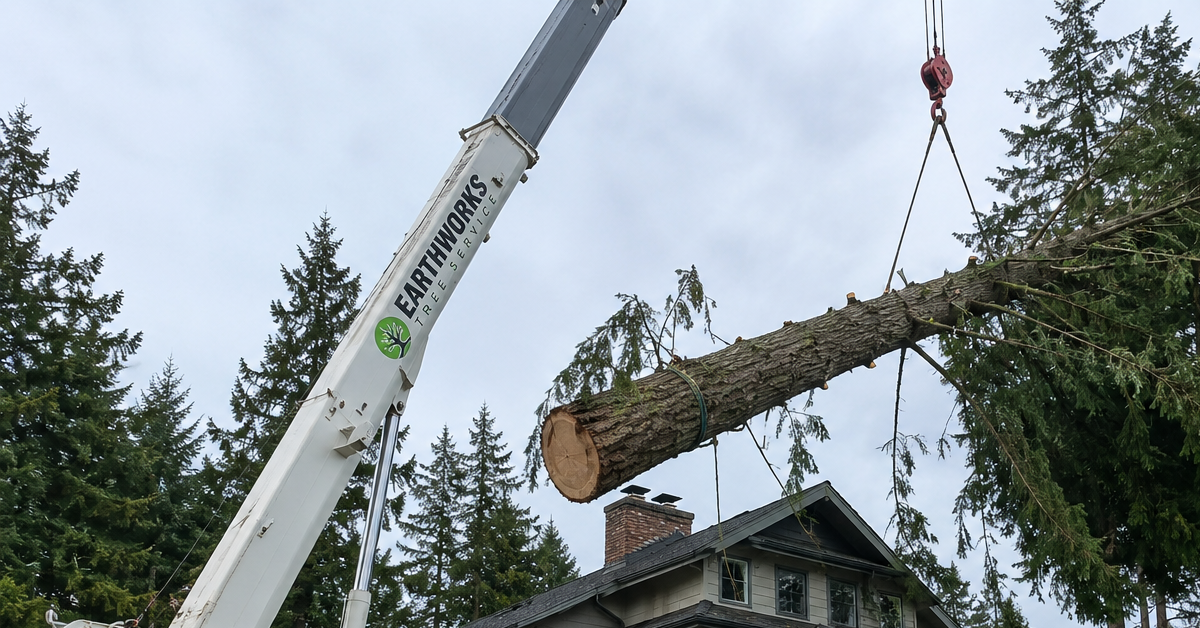
We engaged a 60-ton hydraulic crane positioned in the street in front of the property. Crane work on residential streets in Bellingham requires coordination with the City for any temporary traffic management, which we handled as part of project planning.
The project was overseen by an ISA Certified Arborist and supported by crew members trained in aerial rescue and crane-assisted tree work.
Crew and Equipment Deployed:
- One 60-ton hydraulic crane was positioned and staged the prior afternoon
- A four-person crew consisting of a certified arborist, rigging lead, and two ground crew members.
- Ground chipper for processing brush and small-diameter wood
- Specialized rigging equipment was used to control each lift and protect nearby structures.
Property Protection Measures:
Before any cutting began, we placed protection matting along the travel path of the crane on the adjacent lawn area to minimize soil compaction.
We identified and confirmed the locations of underground utilities on the property, including a water service line running near the root zone, before any root zone work began.
The homeowner was advised to remain inside and away from the work zone for the duration of the project. The street in front of the property was managed with traffic cones and a crew member for flagging during crane setup and primary lifts.
Phase Three: The Removal
Top-Down Sectioning and Crane Lifts:
The arborist ascended using a throwline system and began sectional dismantling from the upper crown.
Each section was rigged to the crane line before the cut was made, allowing controlled lowering to the ground crew rather than freefall.
We worked in sections of approximately 8 to 12 feet through the upper and mid canopy. As we approached the lower trunk section, the rigging was adjusted to account for the shift in center of gravity and the changing direction of lean.
The final trunk section, approximately 18 feet of main stem above the root collar, required the most precise work. With the crane under full tension, the cut was made to allow the section to be extracted vertically rather than swung laterally toward the house.
The lift cleared the roofline by approximately eight feet.
Note: Confined-space removal over occupied structures is not improvised. Every lift is planned before the saw starts. Deviating from the rigging plan mid-cut is how incidents happen.
Phase Four: Root Zone and Stump Work
What the Root Zone Revealed:
After the trunk was removed and the root collar was fully exposed, the extent of the root damage became clear.
The southeast portion of the root system showed extensive Armillaria root rot that had likely been weakening the tree for years. The northeast side showed root shearing associated with the windstorm that had occurred the night before.
Taken together, the decay and root failure had compromised multiple structural roots responsible for anchoring the tree. Based on the condition of the root system, the tree was unlikely to remain stable through another significant wind event.
WSU Extension’s Forestry and Natural Resources program provides detailed guidance on Armillaria management in western Washington landscapes, including soil treatment considerations for replanting after infected trees are removed.
Stump Grinding and Site Restoration:
The stump was ground to approximately 12 inches below grade. Standard grinding practice in PNW residential settings goes deeper than surface level to allow replanting without encountering the stump mass.
Given the confirmed Armillaria infection, we advised the homeowner against replanting in the same location for a minimum of two to three years, and recommended consulting with a horticulturist about species selection and any soil amendment prior to replanting. Armillaria can persist in infected root material for years after the host tree is removed.
We completed debris cleanup, ran all brush through the chipper, and hauled the large wood sections. The site was left clean, with the mulch pile offered to the homeowner for landscape use.
Our stump grinding services include post-grinding cleanup and site review as standard on all projects.
Phase Five: Outcome and Follow-Up Assessment
Outcome for the Homeowner:
The project was completed in a single day, including crane setup and breakdown.
Total project cost included crane rental, four-person crew, equipment, debris removal, and stump grinding. Cost was within the range the homeowner had been quoted during the initial estimate, with no significant cost additions from the actual root zone findings.
The homeowner had delayed the assessment for two years. In our experience, addressing potential stability concerns earlier often reduces both risk and project complexity. By the time we evaluated the tree, the developing lean and root zone movement had significantly increased the complexity of the removal and limited the available management options.
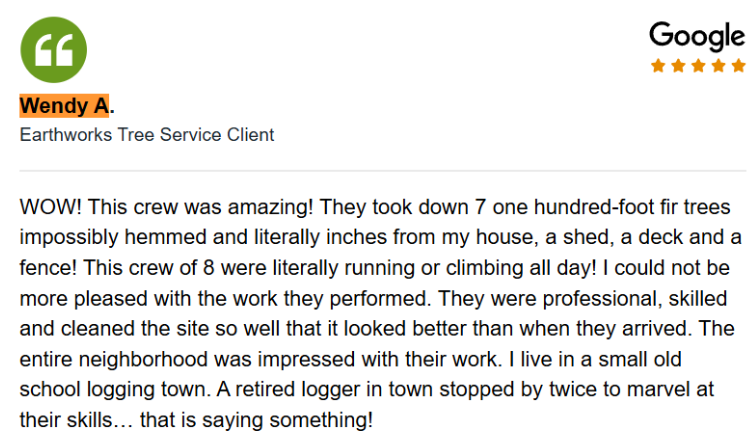
The house sustained no damage. The southeast corner of the home, which was in the tree’s projected fall path, was cleared of risk before the next wet season storm arrived.
Other Trees Assessed During the Follow-Up:
With the homeowner’s permission, we walked the rest of the property following the primary removal.
A second Douglas fir, approximately 65 feet tall on the north side of the property, showed minor crown thinning and a slight buttress root asymmetry on the south side. We recommended monitoring and a follow-up assessment in 12 months.
A western red cedar near the back fence showed no concerning findings and appeared structurally sound.
Our professional tree health assessment service covers multi-tree property evaluations as part of any project, because a single-tree focus often misses the neighboring tree that is in early-stage decline.
Frequently Asked Questions:
How do I know if a tree leaning toward my house is an emergency?
Any tree that has moved to a new lean following a windstorm or rain event requires a same-day professional assessment. Do not wait. Root zone movement that has already begun typically worsens with continued wet conditions. The cost of a same-day assessment is minimal compared to the consequences of waiting.
How long does it take to remove a large Douglas fir over a house?
A full-day project is typical for a complex confined-space removal of this type, including crane setup, sectioning, debris processing, and stump grinding. Straightforward removals in open areas take less time. Projects with additional complications such as utility coordination, structural complexity, or difficult access may extend to a second day.
How much does crane tree removal cost in Bellingham?
Crane-assisted removal adds high cost to a project relative to standard felling because of the rental, operator, and additional crew required. Total project costs for crane-assisted removal of large conifers over structures in the Bellingham area can range from several thousand dollars depending on tree size, site access, crane requirements, and debris volume. A site-specific estimate is the only way to get an accurate number for your project.
Why did the tree look healthy if the roots were so damaged?
Douglas firs can continue looking healthy for years after root problems begin because they store energy reserves in the trunk and canopy. As a result, visible crown decline often appears much later than root damage.
What should I do about the Armillaria fungus left in the soil?
Armillaria can persist in infected root material for several years after a host tree is removed. For replanting purposes, allow a minimum of two to three years before replanting in the same area, and consider species that have known resistance to Armillaria. A horticulturist or plant pathologist can advise on species selection and any soil treatment options before replanting.
Can Earthworks Tree Service assess other trees on my Bellingham property during a project?
Yes. We routinely conduct a broader property walk-through following primary project completion on any Bellingham or Whatcom County property. Request this when scheduling. There is no additional charge for a general visual assessment during the project visit, though a formal written risk assessment for multiple trees is a separate service.
Can a tree look healthy and still be dangerous?
Yes. Many Douglas firs with significant root damage maintain a full green canopy until failure becomes imminent. Root decline often appears years before crown decline.
A Tree That Didn’t Have to Become an Emergency
After the project was complete, the homeowner told us she had been concerned about the tree for nearly two years.
The soil around the base would lift after heavy rain, and the lean seemed slightly different over time. Nothing appeared urgent until a November windstorm changed the situation overnight.
We see this often throughout Bellingham and Whatcom County. Most hazardous trees show warning signs before failure. The challenge is recognizing them early enough to act before a storm turns a manageable problem into an emergency.
In this case, the tree was removed safely before it caused damage to the home.
If you’ve noticed a new lean, soil movement around the base of a tree, exposed roots, cracking soil, or changes following a recent storm, don’t assume the problem will resolve on its own. Many tree failures begin below ground and may not be visible from the canopy.
Schedule a professional tree assessment before the next windstorm puts your property at risk. Earthworks Tree Service provides expert tree risk evaluations, hazardous tree removals, and emergency tree services throughout Bellingham and Whatcom County.