
October 14, 2026
Bigleaf maple limb failure in Bellingham’s wet winters occurs because prolonged rain saturates the soil and weakens root stability, while wet foliage and moss increase branch weight. Strong winds and saturated canopies add stress, especially to large, horizontal limbs. Decay, structural defects, and weak branch unions can make mature maples more vulnerable. Regular tree inspections and pruning of hazardous limbs can reduce the risk of failure.
Why Bigleaf Maples Are So Prone to Limb Failure
Bigleaf maple (Acer macrophyllum) develops broad, spreading canopies with long, heavy limbs that can place significant stress on branch unions. In Bellingham’s wet winters, moss and moisture add extra weight, while strong winds increase bending and twisting forces. Age, decay, and existing structural weaknesses further raise the risk of limb failure.
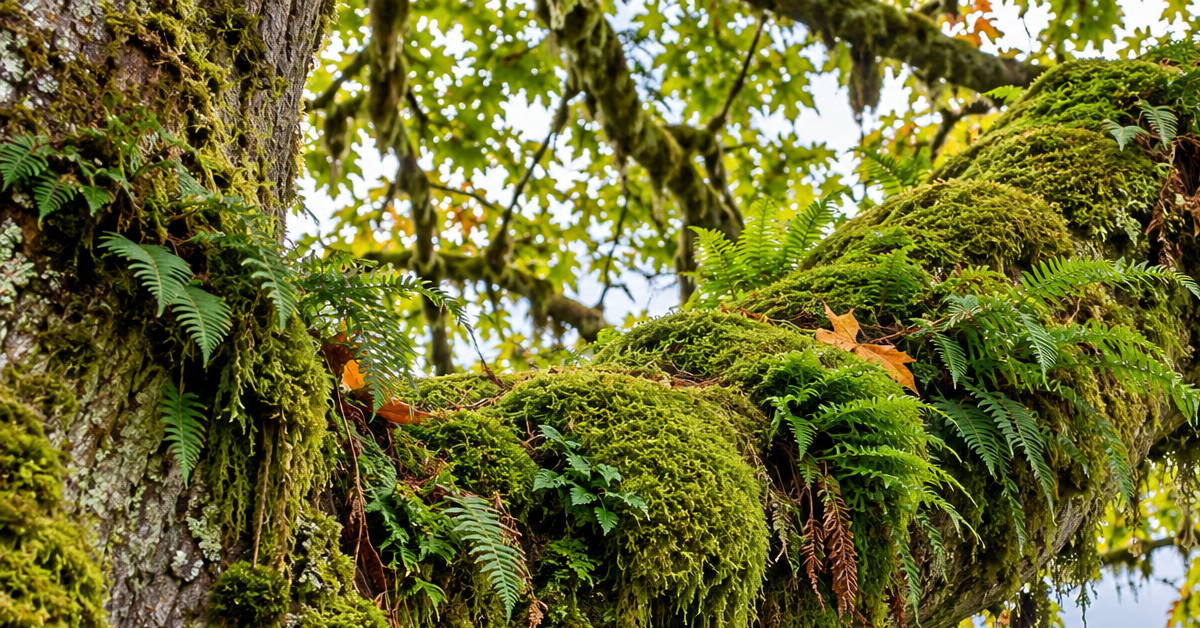
Walk through a Bellingham neighborhood and you will see maples covered in thick moss. Ferns often grow in the moss too. This growth is natural and usually does not harm the tree; however, it adds weight, especially in winter. Moss acts like a sponge, absorbing and retaining water during Bellingham’s prolonged winter rains. As wet moss accumulates along a large limb, its added weight increases the load on the branch.
Rain adds further moisture, while strong winds push and pull the already burdened limb with every gust. This combination of constant weight and repeated movement puts extra stress on the tree, making existing weaknesses more likely to result in limb failure.

Wet Soil Reduces Stability
Bellingham’s winters bring long periods of saturated ground. Soil that is full of water loses strength and roots hold less firmly, and trees move more in the wind. This can lead to whole-tree failure, but it also stresses limbs. A tree that shifts slightly in the soil changes how load travels through its structure. Roots that are damaged by past construction or compaction make the problem worse. Bigleaf maples often grow in yards where trenching, driveways, and patios have affected the root zone.
Weak Branch Unions
One of the most common causes of limb failure is a weak union. Many bigleaf maples have co-dominant stems. These are two or more trunks of similar size that grow from the same point. Between them, bark can become trapped, called included bark.
Included bark prevents the stems from forming a strong wood connection. Instead of locking together, the stems act like a wedge. As the stems grow and add weight, the wedge pushes outward. Eventually, one side may split away in a storm.
You can often spot these unions by looking for a narrow V shape with a dark seam of bark inside. A U-shaped union with a smooth curve is usually stronger. If you see a tight V, have it inspected.
Decay and Fungi
Bellingham’s wet winters create favorable conditions for wood-decay fungi to thrive. Wounds from old pruning cuts, storm damage, and mechanical injuries allow fungi to enter the tree. Over time, decay weakens the wood’s structure, increasing the risk of limb failure.
Look for shelf-like fungi growing on the trunk or limbs, along with soft, spongy wood, cavities, or peeling bark. These can indicate internal decay, although damage is not always visible from the outside. Even a hollow tree may support a full canopy for years, but its weakened structure can leave it vulnerable during severe storms.
Warning Signs to Watch For
You do not need to be an arborist to notice red flags. Here are some warning signs to watch out for:
- Check your maples after each big storm and again in early fall.
- Cracks along limbs or at unions as a crack that opens and closes in the wind is serious
- Large dead branches, which can fall without warning.
- Notice limbs that sag or hang lower than they once did.
- Look at the base for lifted soil, mushrooms, or a new lean.
- Creaking sounds in wind can also mean a limb is moving too much.
The International Society of Arboriculture offers helpful guidance for homeowners on spotting tree problems.
What Happens When a Limb Fails
A large bigleaf maple limb can weigh hundreds of pounds, and sometimes much more. When it falls, it can crush a car, break a roof, or damage a fence. Most failures occur during strong wind or heavy rain, but not always. Some limbs fall on calm days when internal decay finally gives out. That makes regular inspection important. If a limb lands on your home or touches a power line, keep everyone clear and call the utility company and a professional tree expert in Bellinghan, Washington.
How to Reduce the Risk
Good care lowers risk, and it can start small. Begin with a professional inspection. An arborist can climb, probe, and test for decay and weak unions and can recommend a plan based on the tree’s condition. Many solutions are inexpensive when done early.
- Pruning can remove dead wood and reduce the length of overextended limbs.
- Reduction cuts shorten heavy limbs and lower the leverage.
- Pruning should follow accepted standards so cuts heal properly.
- Avoid tree topping, which harms maples and makes new growth weak.
- Cabling and bracing can support co-dominant stems or heavy limbs. They do not remove the defect, but they can limit movement and prevent splitting. They need regular checks.
- Protect the roots. Keep heavy equipment, trenches, and soil piles away from the base. Do not pile mulch against the trunk. These steps help the tree stay stable through wet seasons.
Should You Remove the Moss?
In most cases, no. Moss is not a parasite, and scraping it can hurt the bark. If moss load is a concern, the better solution is to reduce limb length and weight through pruning.
When Removal Makes Sense
Some maples are too decayed or unstable to save. If a tree has a hollow trunk, major root loss, or large cracks in key unions, removal may be the safest option.
The Washington State University Extension and the Washington Department of Natural Resources offer additional information for property owners on tree care and forest health in the state.
Timing Your Inspection
The best time to inspect is before winter storms arrive. Late summer and early fall are ideal. The canopy is full, so you can judge crown condition. Work done then also gives trees time to adjust before the wet season.
Earthworks Tree Service helps Bellingham homeowners identify and address bigleaf maple limb failure risks before winter storms arrive. Our team can inspect trees for weak branch unions, cracks, dead limbs, and visible signs of decay. Through professional tree pruning and trimming, we can remove hazardous branches and reduce excess weight on overextended limbs.
Earthworks Tree Service also offers tree cabling and bracing to provide additional support for structurally weak stems and heavy branches where appropriate. If a maple has extensive decay or severe structural damage, we can assess whether removal is the safest option. Our team can help protect your home, vehicles, and surrounding property from falling limbs during Bellingham’s wet, windy winters. Contact Earthworks Tree Service at – (360) 994-1211 to schedule a tree assessment and prepare your property for the storm season.
Frequently Asked Questions
Why do bigleaf maple limbs fall in winter?
Wet moss, rain, and wind add weight and force. Saturated soil and hidden decay also reduce the tree’s ability to hold up.
Is moss on a maple harmful?
Usually not. Moss is not a parasite. But it adds weight when wet, which can stress long limbs.
How can I tell if a union is weak?
Look for a narrow V-shaped union with included bark between stems. Cracks or splits at the union are major warning signs.
Can a damaged bigleaf maple be saved?
Often yes. Pruning, cabling, and good site care can extend its life. If decay is extensive, removal may be safer.
When should I have my maple inspected?
Inspect in late summer or early fall, and after any major storm. Call right away if you see cracks, hanging limbs, or sudden leaning.