
August 6, 2026
Key Takeaways
- Western Washington’s cool, wet climate naturally supports moss, lichen, and fungi.
- Moss and lichen usually grow on the bark without harming healthy trees.
- Heavy growth often indicates excess shade, moisture, or reduced tree vigor rather than disease.
- Mushrooms and shelf fungi growing from a living tree can be signs of internal decay.
- Improving sunlight, airflow, and overall tree health often reduces favorable conditions for surface growth.
- An ISA Certified Arborist can determine whether these growths are harmless or indicate a structural problem.
If you own property in Western Washington, chances are you’ve noticed green moss creeping across tree trunks, pale gray lichens covering branches, or mushrooms appearing near the base of mature trees. These growths are incredibly common throughout Bellingham, Mount Vernon, Whatcom County, Skagit County, and much of the Pacific Northwest. In fact, they are so widespread that many homeowners wonder whether their trees are unhealthy simply because they’re covered with them.
The good news is that the presence of moss or lichen rarely means a tree is dying. These organisms thrive because Western Washington provides one of the best natural environments in North America for moisture-loving plants and fungi. Frequent rainfall, mild temperatures, high humidity, and extended periods of cloud cover allow them to grow almost year-round. Fungi deserve a little more attention. While some mushrooms simply decompose dead wood, others can indicate that decay is already occurring inside a living tree. Understanding the difference between harmless surface growth and a warning sign of structural weakness helps homeowners make informed decisions about tree care.
Here are the 8 most common reasons moss, lichen, and fungi grow on trees in Western Washington.
1. Western Washington’s Climate Is Ideal for Moss, Lichen, and Fungi
The biggest reason these organisms grow on trees has nothing to do with poor tree health, it has everything to do with the local climate. Western Washington experiences long wet seasons, relatively mild winters, and frequent overcast skies. Tree bark often remains damp for days after rainfall, creating the moisture these organisms need to survive. Unlike drier climates where bark quickly dries in the sun, trees here stay humid for much of the year. Because of these conditions, mosses, lichens, and fungi naturally colonize tree bark, branches, and even exposed roots. Seeing them throughout the region is normal and, by itself, is not a reason to worry.
2. Your Tree Receives Too Much Shade
Shade is another major reason these growths become established. Trees growing beneath larger evergreens, along wooded property lines, or on the north side of buildings receive less direct sunlight throughout the year. Without enough sun, bark dries much more slowly after rain, creating an environment where moss and lichen can spread. This is particularly common in older neighborhoods where mature trees form dense canopies. The growth isn’t necessarily harming the tree, it simply reflects the cool, shaded conditions surrounding it.
3. Poor Airflow Allows Moisture to Linger
Even trees growing in partial sunlight can develop extensive moss or lichen if air circulation is poor. Dense canopies trap humidity and reduce evaporation after rainfall. Interior branches remain damp, especially during the fall and winter months, allowing surface organisms to establish themselves more easily. Professional pruning often improves these conditions by opening the canopy and allowing both sunlight and moving air to reach interior branches. Better airflow also reduces the amount of time bark stays wet, making conditions less favorable for future growth while improving overall tree health.
4. Moss Grows on Trees Because the Environment Is Right
One of the most common misconceptions is that moss feeds on living trees. It doesn’t. Moss is a simple plant that anchors itself to bark for support, but it obtains water and nutrients from rainfall and the surrounding environment rather than from the tree itself. Healthy trees continue to grow normally even when patches of moss cover portions of their bark.
Heavy moss growth can occasionally retain additional moisture or add weight to weakened limbs, but those issues are usually secondary. In most cases, moss is simply telling you that the tree lives in a damp environment. Removing the moss without addressing the underlying conditions rarely produces long-term results because it usually grows back once moisture returns.
5. Lichen Is Usually a Sign of the Environment Rather Than Disease
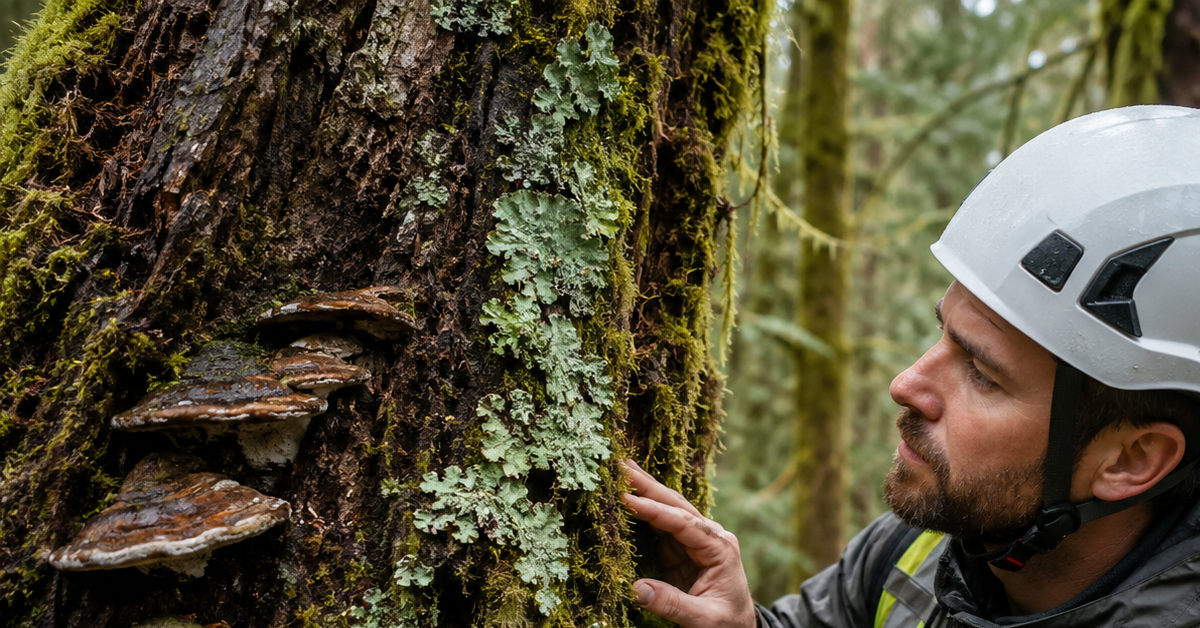
Lichen often causes even more concern because of its unusual appearance. It may look like peeling paint, powdery patches, or crusty gray, green, yellow, or white growth attached to branches and trunks. Although many people mistake it for a disease, lichen is actually a partnership between fungi and algae living together. Neither organism attacks healthy tree tissue. Instead, they use the bark as a stable surface where they can receive moisture and sunlight. Lichens frequently become more noticeable on mature or slow-growing trees because older bark changes more slowly, giving them time to expand. Their presence may indicate that the surrounding environment is cool, humid, and shaded, but it rarely indicates that the tree itself is infected.
6. Your Tree May Be Growing More Slowly or Experiencing Stress
Although moss and lichen usually don’t harm trees, they often become more noticeable on trees that are already under stress. A tree experiencing compacted soil, root damage, drought, poor drainage, limited sunlight, or construction impacts may grow more slowly than a healthy tree. As bark remains unchanged for longer periods, mosses and lichens have more opportunity to establish themselves.
Surface growth alone doesn’t diagnose a problem. However, when it appears alongside thinning foliage, dead branches, premature leaf drop, bark cracking, or canopy decline, it may suggest the tree deserves a closer inspection. An arborist evaluates the entire tree rather than focusing only on the moss or lichen visible on the surface.
7. Fungi May Be Warning You About Internal Decay
Unlike moss and lichen, fungi can sometimes signal a much more serious issue. Mushrooms, shelf fungi, brackets, and woody conks growing directly from a living trunk, major roots, or the root flare often indicate that fungi are breaking down wood inside the tree. Since decay begins internally, a tree may still produce healthy leaves while losing structural strength beneath the bark. This doesn’t mean every mushroom requires immediate removal of the tree. Some fungi simply decompose dead branches or old stumps nearby. The location of the fungal growth, the species involved, and the condition of the tree all influence how serious the problem may be. Because internal decay isn’t always visible from the outside, fungal fruiting bodies should be evaluated by an ISA-Certified Arborist who can determine whether the tree remains structurally sound.
8. Mature Trees Naturally Develop More Moss, Lichen, and Fungi
Age also plays an important role. Older trees develop thicker, rougher bark with deep ridges and crevices that retain moisture more effectively than the smoother bark of younger trees. These textured surfaces provide ideal places for mosses and lichens to become established.
Large maples, cedars, firs, oaks, and ornamental trees throughout Western Washington commonly develop patches of moss or lichen simply because they’ve been exposed to decades of moisture. In many cases, these growths become part of the tree’s natural appearance without affecting its health. For this reason, arborists rarely recommend removing moss or lichen solely for cosmetic purposes.
What Can You Do About Moss, Lichen, and Fungi?
For most homeowners, improving the tree’s growing conditions is far more effective than trying to remove the organisms themselves. Selective pruning allows additional sunlight and airflow to reach the canopy, helping bark dry more quickly after rainfall. Protecting the root zone from soil compaction, avoiding unnecessary bark damage, and maintaining healthy soil all contribute to stronger, more vigorous trees. If mushrooms or woody conks appear on the trunk or around the base of a living tree, avoid assuming they’re harmless. An arborist can identify the fungal species, evaluate the tree’s structural condition, and determine whether monitoring, pruning, treatment, or removal is the safest course of action.
How an Arborist Determines Whether the Growth Is Harmful
Surface growth tells only part of the story. During an inspection by an ISA-Certified Arborist in Western Washington evaluates the tree as a whole, considering its species, age, overall vigor, canopy density, root condition, structural defects, and the exact location of moss, lichen, or fungal growth. In many cases, homeowners discover that the moss or lichen they’ve worried about for years is completely harmless, while a small fungal conk near the base reveals a hidden structural issue that deserves attention. Professional evaluation removes the guesswork and helps ensure that healthy trees are preserved while hazardous ones are addressed before they become a safety risk.
If you’re unsure whether moss, lichen, or fungi are harmless or a sign of tree decline, Earthworks Tree Service can help. We offer Consultation, Permitting, and Reporting services where our ISA-Certified Arborists inspect the tree’s overall health, structure, and any visible fungal growth to determine whether further action is needed. Earthworks Tree Service’s arborists provide science-based recommendations tailored to your tree’s condition and our team helps homeowners make informed decisions to keep their trees healthy and safe. For more information, get in touch with our team at – (360) 994-1211 to Book Your Free Estimate !
Frequently Asked Questions About Moss, Lichen, and Fungi in Western Washington
Is moss bad for my tree?
Usually not. Moss grows on the bark rather than inside the tree and is generally considered harmless. Heavy growth simply reflects moist, shaded conditions.
Is lichen harmful to trees?
No. Lichens are non-parasitic organisms that use bark as a surface for growth. They do not take nutrients from healthy trees.
Why are mushrooms growing on my tree in Western Washington?
Mushrooms growing from a living tree may indicate internal decay or root rot. While not every fungus is dangerous, they should be inspected by an ISA Certified Arborist.
Can pruning reduce moss and lichen?
Yes. Proper pruning improves airflow and increases sunlight, helping bark dry more quickly and making conditions less favorable for excessive growth.
Should I remove moss or lichen myself?
Generally, no. Scrubbing bark can damage living tissue. Improving tree health and site conditions is usually a more effective long-term solution.
Summary Checklist: Tree Growths, Causes, and Risk Levels
| Growth Type | What It Usually Means | Why It Matters |
| Moss on bark or limbs | Moist, shaded conditions. | Usually harmless, but heavy buildup can hold moisture. |
| Lichen on branches or trunk | Cool, damp, low sunlight environment. | Generally nonparasitic, but may suggest a slow growing tree. |
| Mushrooms at the base | Possible decay or root issues. | Can indicate internal structural weakness. |
| Shelf fungi or conks | Advanced wood rot in some cases. | Often a stronger warning sign than moss or lichen. |
| Thick growth across the canopy | Poor airflow and excess moisture. | Can contribute to slower drying and tree stress. |
| Growth plus dieback or cracks | Tree decline may be occurring. | Needs professional inspection to assess risk. |
Final Advice
Moss, lichen, and fungi are part of the natural landscape throughout Western Washington. In most cases, moss and lichen simply reflect the region’s cool, wet climate rather than indicating disease or decline. Their presence alone is rarely a reason to remove a tree. Fungi require a more careful assessment because some species can signal internal decay long before a tree shows obvious symptoms. If you notice mushrooms emerging from the trunk or root flare, large areas of dieback, major cracks, or other structural concerns, it’s wise to schedule an inspection with a professional & ISA-Certified tree service firm in Western Washington. Whether your tree needs pruning to improve airflow, ongoing monitoring, or removal for safety, a professional evaluation provides the clarity needed to protect both your property and your landscape. To learn more about how Earthworks Tree Service can assist you, call our team at – (360) 994-1211 to Book Your Free Estimate !