
August 26, 2026
Key Takeaways
- Atmospheric rivers bring some of the heaviest, most sustained rainfall events in the Pacific Northwest, often combined with strong wind.
- Saturated soil dramatically reduces a tree’s root anchorage, making trees more likely to lean or uproot even without extreme wind speeds.
- Bellingham and Skagit County’s mix of shallow-rooted conifers and wet, low-lying soils makes the region especially vulnerable during these events.
- Trees that survive one atmospheric river event can still be structurally weakened and more vulnerable the next time a storm rolls through.
- Earthworks Tree Service provides storm-season inspections and 24/7 emergency response across Whatcom and Skagit counties to help property owners stay ahead of these risks.
Anyone who’s lived in Bellingham or Skagit County through a fall or winter storm season knows the feeling of days of steady, heavy rain that just doesn’t seem to let up. Often, that’s an atmospheric river at work, a long, narrow band of concentrated moisture moving in from the Pacific that can dump several inches of rain on Northwest Washington over the course of a day or two. These events are a defining feature of the region’s weather, and they’re also one of the biggest drivers of tree failure across Whatcom and Skagit counties every year.
Understanding how atmospheric rivers actually affect tree stability, and not just how much rain falls, helps property owners recognize which trees are at the greatest risk before the next big storm arrives.
What Makes Atmospheric Rivers Different From a Typical Storm
A typical rainstorm might drop half an inch to an inch of rain over several hours. An atmospheric river event can deliver several inches over one or two days, often with sustained wind gusts layered on top. That combination, prolonged saturation plus wind loading, is much harder on trees than either factor on its own.
The Pacific Northwest sees a disproportionate share of the nation’s most intense atmospheric river events, and Whatcom and Skagit counties, sitting right in the path of these systems as they move inland off the Salish Sea, get hit directly. For trees, it’s not just about how much rain falls, it’s about how long the ground stays saturated and how much additional wind stress the canopy has to absorb while the roots are at their weakest.
How Saturated Soil Undermines Root Stability
Tree roots rely on soil structure for anchorage the same way a foundation relies on solid ground. When soil becomes fully saturated during an extended rain event, the spaces between soil particles fill with water instead of air, and the soil essentially loses much of its holding strength. Roots that were firmly gripping the ground in dry conditions can start to lose that grip as the surrounding soil turns soft and unstable.
This effect is amplified in low-lying areas, near drainage ditches, or anywhere water tends to pool rather than drain quickly, conditions that are common across parts of Skagit County’s flatter agricultural land and some of Bellingham’s lower-elevation neighborhoods. A tree that’s stood solidly through years of normal rainfall can become genuinely unstable during a multi-day atmospheric river event simply because the ground beneath it has temporarily lost its ability to hold the root system in place.
Why Local Tree Species Are Particularly Vulnerable
Northwest Washington’s forests are dominated by conifers like Douglas fir, western red cedar, and western hemlock, many of which have relatively shallow, wide-spreading root systems rather than deep taproots. That root structure works well in the region’s typically moist soil under normal conditions, but it also means these trees depend heavily on soil friction and root spread for stability rather than deep anchoring.
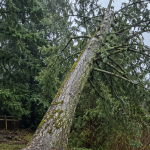
When that soil turns soft and waterlogged during an atmospheric river event, shallow-rooted conifers lose a larger share of their stability than deeper-rooted species might. Combine that with the added wind load on a full, heavy canopy, particularly for cedars and firs that hold their needles year-round, and you get one of the most common failure patterns during Northwest Washington storm season: full uprooting rather than just limb breakage.
Warning Signs After an Atmospheric River Event
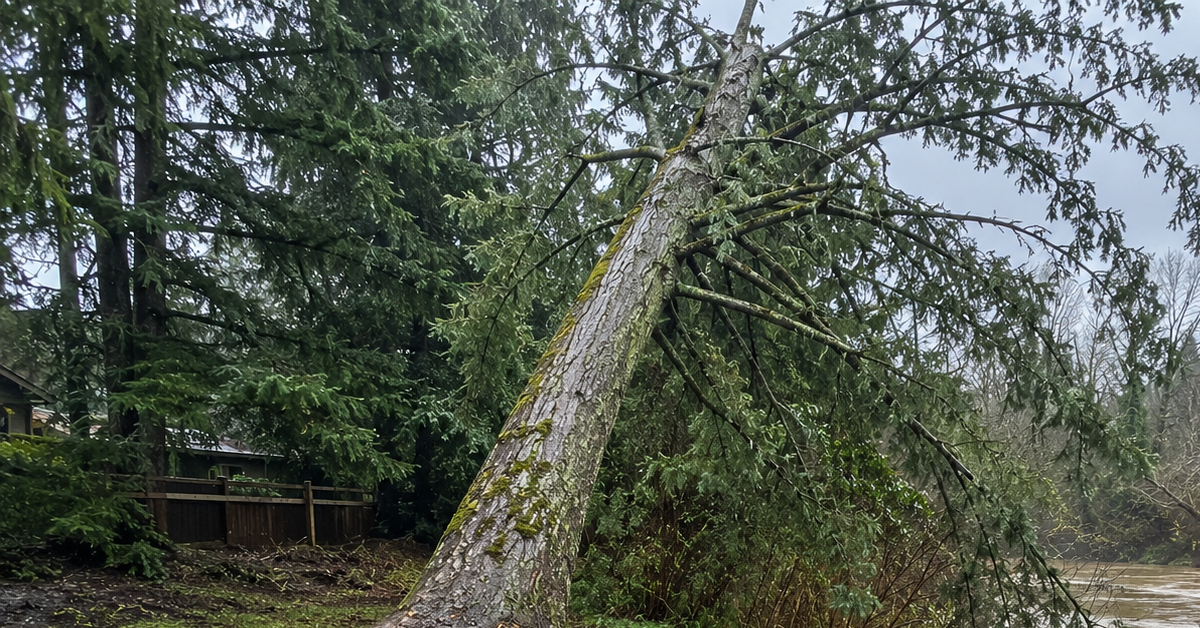
After a heavy, sustained rain event, it’s worth walking the property and checking for a few specific signs that a tree’s stability may have been compromised, even if it’s still standing upright:
- A new or more pronounced lean that wasn’t there before the storm.
- Cracked or heaved soil around the base of the trunk, which can indicate the root plate has shifted.
- Standing water that’s remained pooled around the tree’s root zone for an extended period.
- Exposed roots on one side of the trunk that weren’t visible before.
- Branches that dropped during the storm but weren’t fully cleaned up, which can signal a stressed canopy.
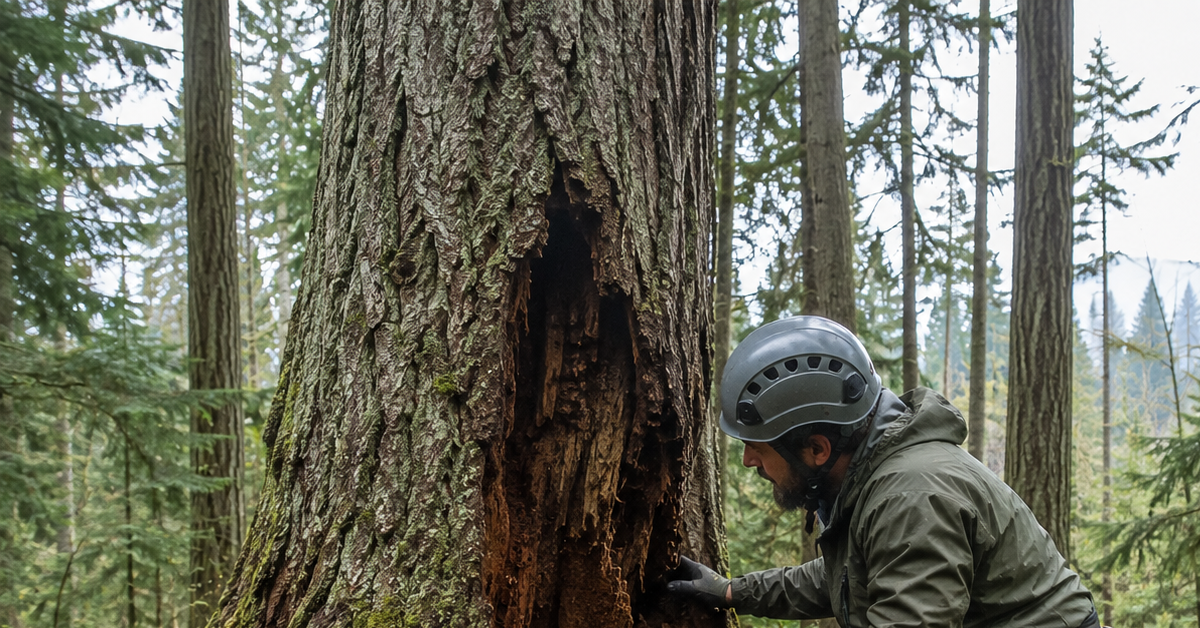
Any of these signs, particularly a new lean or heaved soil, are worth having an experienced & certified arborist in Bellingham and Skagit County, Washington State look at promptly, since a tree that’s been destabilized by one event is often more vulnerable during the next one, even if it survived the first storm without falling.
Why Cumulative Storm Damage Matters
One of the trickier aspects of atmospheric river risk is that the damage doesn’t always show up all at once. A tree can come through one storm slightly weakened, with a root system that’s lost some of its grip but hasn’t fully failed. Without an inspection, that weakened state can go unnoticed until the next major rain event pushes the tree past its limit.
This cumulative effect is part of why storm-season monitoring matters more in a region that sees repeated atmospheric river events through the fall and winter than it would in a climate with only occasional severe weather.
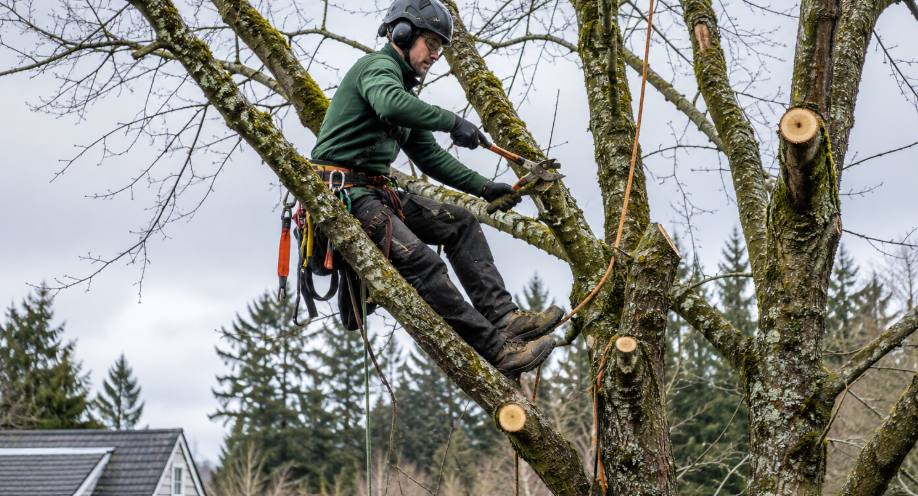
Earthworks Tree Service helps property owners across Bellingham and Skagit County prepare for atmospheric river events and respond when storms cause tree damage. Our ISA-certified arborists can inspect trees for root instability, structural weakness, and storm damage, while our experienced crews provide professional tree pruning & trimming, cabling and bracing, tree removal, and stump grinding. Earthworks Tree Service proudly serves Bellingham, Mount Vernon, and communities throughout Whatcom and Skagit counties.
Frequently Asked Questions About Atmospheric Rivers Affect Tree Stability in Bellingham and Skagit County, WA
What exactly is an atmospheric river?
It’s a long, narrow band of concentrated water vapor that moves through the atmosphere from the tropics or the Pacific toward the coast, often producing heavy, sustained rainfall over a day or two when it makes landfall.
How much rain can an atmospheric river bring to Bellingham or Skagit County?
Amounts vary by storm, but these events can deliver several inches of rain in a short period, well above what a typical winter storm produces in the region.
Can a tree recover from root damage caused by saturated soil?
Some trees do recover once the soil dries out and re-firms around the root system, particularly if the damage was minor. More significant root plate movement usually calls for a professional stability assessment.
Is it safe to remove a leaning tree myself after a storm?
Storm-weakened trees can be unpredictable, with compromised roots or hidden internal damage. This work is best handled by a trained crew with proper rigging and safety equipment.
When should I schedule a storm-season inspection?
Ahead of the fall and winter rainy season is ideal, since it lets an arborist flag vulnerable trees before the heaviest atmospheric river events typically arrive.
Summary Checklist: Is Your Tree at Risk After an Atmospheric River Event?
| Situation | What to Check | What to Do |
| New lean after heavy rain | Root plate stability | Schedule an arborist evaluation |
| Heaved or cracked soil at the base | Possible root movement | Get a risk assessment promptly |
| Standing water pooled at the root zone | Prolonged soil saturation | Improve drainage and monitor tree |
| Shallow-rooted conifer near structures | High-consequence failure location | Prioritize for storm-season inspection |
| Tree survived a prior storm with visible stress | Cumulative structural weakening | Schedule ongoing monitoring |
Final Advice
Atmospheric rivers are a defining part of Northwest Washington’s weather pattern, and they put a very specific kind of stress on trees, one built more on prolonged soil saturation than on wind speed alone. Property owners in Bellingham and Skagit County who understand that difference are better positioned to catch a weakened tree before it fails, rather than after.
Earthworks Tree Service has served Whatcom and Skagit counties for 25 years, with ISA-certified arborists, full licensing and insurance, and 24/7 emergency response for storm damage. We offer free estimates for storm-season inspections and stability assessments across Bellingham, Mount Vernon, and the surrounding area.
Reviewed by a Certified Arborist
This article has been reviewed by a certified arborist to ensure accuracy with current storm-related tree risk guidelines.
Sources & Credible References