
July 20, 2026
Whatcom County gets over 50 inches of rain per year in many areas.
That moisture keeps this region green, dense, and visually spectacular. But for the trees on your property, that same water tells a different story below the surface.
In our experience working across Whatcom County, the most common and most serious tree problems we find are root problems. They develop quietly, invisible from above, and they almost always trace back to the same source: saturated soil, poor drainage, and conditions that the Pacific Northwest delivers year after year.
By the time the damage shows above ground, the root system has often been compromised for months or even years.
Key Takeaways:
- Whatcom County’s high rainfall and shallow, clay-heavy soils create chronic root stress conditions for many tree species.
- Root rot fungi such as Armillaria and Phytophthora are widespread in the Pacific Northwest and spread more aggressively in wet conditions.
- Trees with compromised root systems can appear healthy in the crown for months before structural failure occurs.
- Douglas fir, big-leaf maple, and western red cedar each respond differently to soil saturation and require different assessment approaches.
- Professional root zone inspection is the only reliable way to identify subsurface decline before it becomes a hazard.
- Drainage improvements around the root zone can meaningfully extend the life of at-risk trees.
What Is Tree Root Health?
Tree root health refers to the structural and biological integrity of a tree’s root system, including its capacity to anchor the tree, absorb water and nutrients, and resist fungal pathogens. In the Pacific Northwest, root health is closely tied to soil saturation levels, drainage quality, and the presence of water-borne fungal diseases that thrive in consistently wet conditions.
Why Does Root Health Matter So Much in the Pacific Northwest?
In drier climates, root systems develop deeper and more extensively. In Whatcom County’s wet, clay-heavy soils, root systems often grow shallow and wide rather than deep. This makes Pacific Northwest trees more vulnerable to windthrow, root rot, and structural failure than the same species growing in drier regions. A tree that looks healthy from street level may have a root system that is actively failing.
When Should You Assess Tree Root Health on a Whatcom County Property?
Schedule a professional root and structural assessment after any period of prolonged wet weather, after a windstorm event, if you notice any leaning, crown thinning, or bark discoloration at the base of the tree, or if neighboring trees on similar soil have recently failed or been removed. Do not wait for visible symptoms. Root decline often precedes visible crown symptoms by a full growing season.
How Whatcom County Soil Conditions Create Root Problems:
The Problem With PNW Clay Soils:
Most Whatcom County properties sit on soils that drain slowly and compact easily.
Heavy clay content means water does not percolate quickly. After extended rain events, which are routine from October through April, root zones stay saturated for days or weeks at a time. Roots in saturated soil cannot access the oxygen they need for normal function.
This oxygen deprivation weakens roots even before fungal pathogens arrive. A root system stressed by chronic waterlogging becomes increasingly susceptible to disease, and Whatcom County has no shortage of organisms waiting to take advantage of it.
Shallow Rooting in the Pacific Northwest:
Many property owners in Bellingham and across Whatcom County are surprised to discover that the large trees on their properties have root systems that extend only 18 to 24 inches deep.
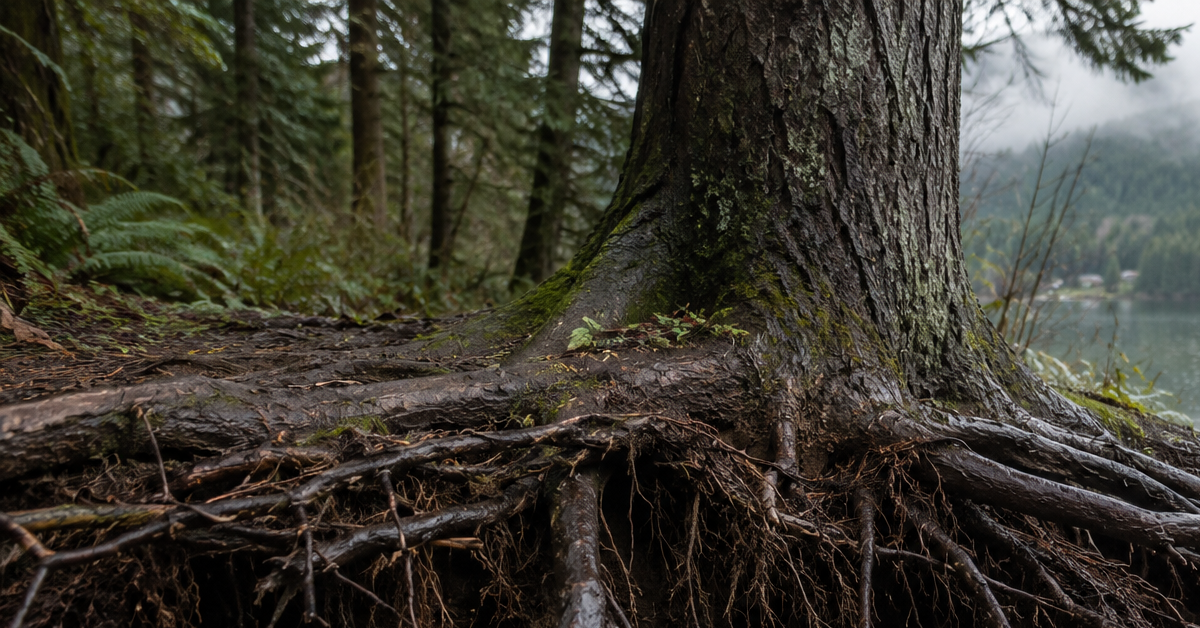
In the dense, wet soils of the PNW, deep root development is limited. Root systems spread laterally rather than downward, sometimes extending well beyond the drip line of the canopy but rarely reaching the depths seen in drier regions. This shallow anchoring creates real wind failure risk, particularly on exposed properties near Bellingham Bay, Lake Whatcom, or elevated terrain in eastern Whatcom County.
In our experience, trees that fail during Puget Sound windstorms frequently show root systems that look intact from above but are rotted through at the attachment zone.
The Root Diseases Most Common in Whatcom County:
Armillaria Root Rot:
Armillaria, commonly called honey fungus, is one of the most widespread tree pathogens in the Pacific Northwest.
It spreads through root-to-root contact and through underground rhizomorphs, and it is nearly impossible to eradicate from infected soil. It attacks a wide range of species, including Douglas fir, big-leaf maple, and western red cedar.
The first visible signs are often crown thinning, reduced new growth, and yellowing foliage. By that point, significant root and basal tissue is already destroyed. We frequently see Whatcom County properties where one tree has been lost to Armillaria, and the pathogen has already moved underground to neighboring trees.
Phytophthora Root and Crown Rot:
Phytophthora is a water mold that thrives precisely in the conditions Whatcom County delivers: cool temperatures, high moisture, and periods of soil saturation.
It attacks feeder roots first, which reduces the tree’s ability to absorb water and nutrients even before structural roots are affected. Ironically, a tree being killed by Phytophthora root rot often shows wilting and drought stress symptoms because the damaged roots can no longer supply adequate moisture to the crown.
A common issue on Whatcom County properties is Phytophthora damage in trees growing in low areas, near downspouts, or in ground that holds water after rain events. Improving drainage around the root zone can significantly slow disease progression.
Laminated Root Rot:
Phellinus weirii causes laminated root rot, a fungal disease particularly destructive to Douglas fir throughout the Pacific Northwest.
It spreads slowly through root contacts and creates characteristic “infection centers” where multiple trees show decline simultaneously. Washington State University’s Forestry and Natural Resources program has documented extensive information on this pathogen’s impact on managed and residential forest stands in western Washington.
Properties in Whatcom County with dense Douglas fir stands should be assessed periodically for the spreading decline patterns characteristic of laminated root rot.
How Pacific Northwest Rain Events Accelerate Root Damage:
The problem is not just the total annual rainfall. It is the timing and duration of wet events.
Whatcom County receives most of its precipitation between October and April. This extended wet season means root zones stay continuously saturated through the months when trees are most dormant and least able to actively manage excess moisture.
Freeze-thaw events in late winter add stress to root tissue that is already weakened by prolonged saturation. Roots damaged by cold and waterlogging lose their structural connection to the soil, which increases the risk of windthrow during the wind events that frequently accompany late winter storms moving through the Salish Sea region.
The Washington State Department of Natural Resources monitors forest health conditions across Washington, including disease and hazard assessments relevant to property owners managing trees in western Washington counties, including Whatcom.
Many property owners are surprised to discover that their tree failures happen not during the worst storms, but during relatively moderate wind events following extended wet periods. Root system failure is cumulative, not instantaneous.
Tree Species and Root Health: What Whatcom County Owners Need to Know:
Douglas Fir:
Douglas fir is the dominant conifer on most Whatcom County properties and is generally well-adapted to the region.
However, older and larger Douglas firs on properties with drainage problems or adjacent to areas of prior logging are at elevated risk for laminated root rot and Armillaria. Root collar inspection is particularly important for mature Douglas firs. The Wikipedia overview of Douglas fir notes that Pacific Coast varieties can reach heights of 200 to 300 feet, making structural root failure a high-consequence event on residential properties.
A Douglas fir that was vigorous and healthy ten years ago may have a root zone undergoing active decline today, particularly if nearby trees have been removed and drainage patterns have shifted.
Western Red Cedar:
Cedar is highly tolerant of wet conditions and typically performs well in Whatcom County’s climate.
That tolerance does not make it immune to root problems. In our experience, western red cedar on sites with perennial standing water or compacted soils shows significantly reduced lifespan and elevated susceptibility to Armillaria. Cedar that has been topped, structurally damaged, or subjected to soil compaction from construction activity is at particular risk.
Big-Leaf Maple:
Big-leaf maple is prolific across Whatcom County and can be magnificent when healthy.
It is also one of the species we most commonly assess for root and structural problems. Big-leaf maple tends to develop aggressive surface root systems that respond poorly to construction impacts, soil compaction, and grade changes. Maples in urban Bellingham neighborhoods where surrounding soil has been disturbed by driveway work, utility trenching, or construction consistently show accelerated root decline.
Signs of Root Problems You Can See From Ground Level:
Visible signs of root system stress include:
Thinning crown: Reduced foliage density and smaller-than-normal leaf or needle production often signal that roots are failing to supply adequate water and nutrients.
Off-color foliage: Premature yellowing, browning, or a generally muted foliage color can indicate root stress, particularly in late summer when trees should look their most vigorous.
Bark staining or fungal growth at the base: White or yellow-brown fungal growth near the root collar, or dark staining and wetness on the bark at the base of the trunk, are warning signs of active root pathogen activity.
Visible root zone changes: Soil lifting, soil pulling away from the base of the trunk, or changes in the grade around the root zone can indicate root movement or structural failure in progress.
Leaning at a new angle: Any tree that has moved from its prior vertical position, even slightly, following a wet period or windstorm deserves immediate professional evaluation.
Scheduling a professional tree health assessment is the only way to evaluate what is happening below the surface. Ground-level inspection can identify symptoms, but root zone and structural evaluation require hands-on professional assessment.
What Professional Root Assessment Involves:
A professional assessment of root health on a Whatcom County property involves more than looking at the tree.
It includes evaluation of the root collar and basal bark for signs of decay, fungal activity, and bark separation. It also includes assessing soil conditions and drainage patterns around the root zone, checking for soil compaction from past construction or vehicle traffic, identifying nearby infrastructure that may have damaged surface roots, and evaluating crown condition as a downstream indicator of root health.
In cases where internal decay is suspected, probing and resistograph testing can identify hollow sections in the trunk and root crown that are not visible from the outside.
Professional arborist certification standards, maintained through the International Society of Arboriculture, establish the training baseline for professionals performing these assessments. When a tree’s structural integrity is in question, that training matters.
If assessment reveals active hazard risk, our tree removal services can address the situation safely. For trees that are declining but not yet at the removal threshold, targeted drainage improvements and root zone management can slow disease progression and extend the useful life of valuable trees.
Frequently Asked Questions
How do I know if my tree has root rot in Whatcom County?
Early signs include crown thinning, reduced growth, off-color foliage, and fungal growth or staining near the base of the trunk. However, root rot often progresses significantly before visible symptoms appear above ground. A professional assessment is the only reliable way to evaluate root zone health before a problem becomes an emergency.
Does all the rain in Whatcom County damage tree roots?
Rain alone does not damage roots. The problem is soil saturation, which limits oxygen availability in the root zone. Roots in well-draining soil can handle high rainfall. Roots in compacted, clay-heavy, or poorly drained soil are subjected to chronic stress during Whatcom County’s extended wet season, which increases vulnerability to fungal pathogens.
Can you save a tree with root rot?
It depends on the extent of root loss and the specific pathogen involved. Trees with early-stage Phytophthora damage in a localized area may respond to drainage improvements and root zone management. Trees with widespread Armillaria infection or significant structural root loss generally cannot be safely retained. A professional assessment is needed to determine which category a tree falls into.
Are Douglas firs prone to root problems in Whatcom County?
Douglas firs in Whatcom County can develop root problems, particularly laminated root rot and Armillaria, especially in sites with drainage issues or where neighboring trees have been recently removed. Regular professional inspection of mature Douglas firs on residential properties is a reasonable precaution, particularly for trees over 60 feet that are close to structures.
Should I be worried about trees leaning toward my house after winter storms?
Yes. A tree that has moved to a new lean following a wet period or windstorm event has experienced root zone movement. This is a structural warning sign that requires immediate professional evaluation. Do not wait for the tree to correct itself. Root system failure that has begun generally progresses, particularly with continued wet conditions.
How does construction near trees affect root health?
Construction activity is one of the most common causes of tree decline on Whatcom County properties. Soil compaction from equipment, root severance from trenching for utilities or driveways, and grade changes that alter drainage around the root zone all cause significant root damage. Trees impacted by construction activity may appear healthy for one to three years before symptoms of root stress become visible.
Can drainage improvements help protect tree root health?
In many cases, yes. Reducing the duration of soil saturation around a tree’s root zone can meaningfully slow the progression of Phytophthora and reduce the chronic oxygen deprivation that weakens roots. French drains, grading adjustments, and soil aeration can all be part of an effective root zone management strategy for trees on susceptible sites.
Your Trees Survived Another Wet Season. But Are Their Roots Still Healthy?
Root problems rarely improve on their own. In Whatcom County’s wet climate, root decay and structural instability often progress long before visible symptoms appear in the canopy.
Many emergency tree failures begin with warning signs such as soil movement, leaning, crown thinning, or changes following prolonged rainfall or construction activity. Identifying these issues early can reduce risk and help avoid costly emergency removals.
At Earthworks Tree Service, we provide professional tree health and risk assessments throughout Whatcom County, Bellingham, and surrounding communities. If you are concerned about a tree on your property, schedule an evaluation and get a clear understanding of its condition, risk level, and management options.
Contact Earthworks Tree Service today to schedule a professional tree root and structural assessment.